Guides
Free Limo Software: What You Really Get
Free trials, freemium plans, plugins and spreadsheets can get a small limo company started. Here is what they include, the limits you hit and how to compare real costs.
EazyLimo Team 7 min read
When you are starting a limo or black car business with one car and a tight budget, "free" is an attractive word. Every dollar not spent on software can go to insurance, fuel or a better vehicle. And there are free options: trials, freemium plans, booking plugins and the spreadsheet that runs half the small businesses in the country.
The question is not whether free tools exist. It is what you actually get, where the cost shows up later, and when it makes sense to pay for something you control. This guide walks through each type of free option, the limits operators run into, the hidden costs to look for, and a checklist to use before you commit. Any numbers here are hypothetical examples, not prices of any real product.
The kinds of free you will find
| Type | What you usually get | Where the cost shows up |
|---|---|---|
| Free trial | The full product for a limited time | A subscription when the trial ends, plus the work of setting it all up |
| Freemium plan | A limited version, free for as long as you stay within the limits | Caps on bookings or vehicles, branding, fees, and upgrades for key features |
| Free booking plugin for your own website | A booking form that runs on a site you manage | Hosting, theme, paid add-ons, a maps key, updates and your time |
| General free booking or scheduling tool | Appointment slots and a simple booking page | No distance-based quotes or flight details, so you still quote by hand |
| Spreadsheet and online form | A way to collect requests and keep a list | Every quote, confirmation, payment and reminder is manual |
The limits you hit
Free tools are usually designed to be outgrown. These are the limits small operators most often run into.
Booking, vehicle and user caps
Freemium plans often cap the number of bookings per month, vehicles, drivers or admin users. The cap feels generous until your first busy month, and then the upgrade is not optional.
Someone else's branding
Free booking pages often show the provider's logo, sit on the provider's domain, or link to other operators. For a small company trying to look established, that undermines the whole point.
No real limo pricing
General booking tools are built for haircuts and consultations with fixed prices. Limo pricing needs distance, mileage bands, minimum hours, flat routes, airport surcharges and gratuity. Without them, you are back to quoting every trip by hand. Our rate guide for operators shows how many moving parts a real rate card has.
Missing airport details
Airport work needs flight numbers, bag counts and meet and greet. Generic forms can add custom fields, but nothing uses them to plan the trip.
No dispatch, drivers or corporate billing
Free tools rarely include a dispatch board, driver assignment, trip texts, corporate accounts with several bookers, PO numbers or monthly invoices. Those are often the features you need once the business grows.
Limited export and support
Some free plans restrict data export or offer support only by email with slow replies. That matters on the day something breaks before an early airport pickup.
Hidden costs to look for
- Per-booking fees or commissions. A small fee on every ride can add up to more than a subscription over time.
- Payment markup. Some platforms process card payments through their own account and add a percentage on top of normal processing fees. Ask whether payments go directly to your own payment account.
- Paid add-ons. Texts, extra users, custom domains, removing branding and reports are common upgrades.
- Plugin running costs. A free plugin still needs hosting, a theme, security updates, backups and often a mapping key for distance quotes. Our comparison of limo website templates and done-for-you websites goes into this in detail.
- Your time. Every hour spent quoting by hand, fixing a plugin or chasing payments is an hour you are not driving or selling.
- Switching costs. Moving your bookings, customers and booking link later takes work, and a link on someone else's domain may simply stop working.
How to compare real cost over three years
Monthly prices hide the true cost. Compare options over three years using this method.
- Estimate your bookings per month now and in a year.
- Add up any subscription you would need once you outgrow the free limits.
- Add per-booking fees multiplied by your expected bookings.
- Add any payment markup above normal processing fees, based on your expected revenue.
- Add paid add-ons, hosting and other running costs.
- Put a value on the hours you spend on manual work each month.
| Hypothetical example | Calculation | 3-year cost |
|---|---|---|
| "Free" plan with a per-booking fee | For example, $2 x 40 bookings a month x 36 months | $2,880 |
| Manual quoting time | For example, 4 hours a month x $30 an hour x 36 months | $4,320 |
These figures are invented to show the method. The point is that "free" can quietly cost more than a paid option once fees and time are counted.
Free versus owning once
There are three broad ways to pay for limo booking software, and each fits a different stage.
| Approach | Upfront | Ongoing | Who controls the site and data |
|---|---|---|---|
| Free or freemium | Nothing | Limits, fees or upgrades as you grow | Usually the provider |
| Subscription software | Often nothing or a setup fee | A monthly fee for as long as you use it | The provider, while you keep paying |
| Owned website with booking built in | A one-time build fee | Optional hosting and updates | You |
Our guide to limo booking software for small companies compares these approaches in more depth, and how much a limo website costs breaks down the website side.
What happens when you outgrow a free plan
The move away from a free tool rarely happens at a good time. It usually comes during your busiest month, when the booking cap is reached or a corporate client asks for a monthly invoice the free plan cannot produce. Plan for it before you start.
- Your booking link. If customers, hotels and your Google Business Profile all point to a booking page on the provider's domain, every one of those links has to change when you leave. A booking page on your own domain avoids this.
- Your customer list. Repeat customers are the most valuable thing a small limo company has. Make sure you can export names, phone numbers, emails and trip history.
- Your rates. Rebuilding flat routes, mileage bands and surcharges in a new system takes time. Keep a copy of your rate card outside the software.
- Future bookings. Trips already booked for the coming weeks need to move across without being missed or double charged.
- Reviews and search visibility. If your only web presence was a free booking page, you start from zero in search when you move to your own website.
None of this means you should avoid free tools. It means you should treat them as temporary and keep your own records from day one.
When free is the right choice
Free tools are not a mistake. They make sense when:
- You are still waiting on operating authority or insurance and just want to collect interest.
- You take only a few bookings a month, mostly from people who already know you.
- You are testing a new service, such as party bus work, before committing.
- You are happy to quote and confirm every trip by hand for now.
Once online bookings become a regular part of your income, the limits and fees start to cost more than they save.
Checklist before you commit
- Does it quote instantly from my own rates, including mileage, minimums and flat routes?
- Does it collect flight details for airport trips?
- Can customers pay by card into my own payment account?
- Are there per-booking fees, commissions or payment markups?
- What are the booking, vehicle and user limits on the free plan?
- Does the booking page use my domain and my branding?
- Can I export bookings, customers and rates, and in what format?
- Does it support drivers, dispatch and corporate invoices when I need them?
- Who fixes it when it breaks, and how quickly?
- What will it cost over three years at the volume I expect?
For more on setting up online booking with one vehicle, read online booking for a one-car limo business.
Where EazyLimo fits
EazyLimo is not free, and it is not for everyone. It is a done-for-you limo website with online booking built in, made for owner-operators with one or two vehicles. You can pay once and own it for $999, or $499 at the founding price for the first 25 operators, with optional hosting and updates for $199 a year. If you prefer, there is a monthly option at $79 a month with a 12-month minimum, where you do not own the site. It includes instant quotes from your own rates, airport bookings with flight details, card payment through your own Stripe or PayPal account, a dispatch board, driver assignment with trip texts, corporate accounts with monthly invoices, and farm-out by link. It does not sync with QuickBooks. Full details are on the pricing page.
Next steps
- List the free tools you use or are considering, and note their limits.
- Estimate your bookings per month and run the three-year cost method.
- Go through the checklist for each option.
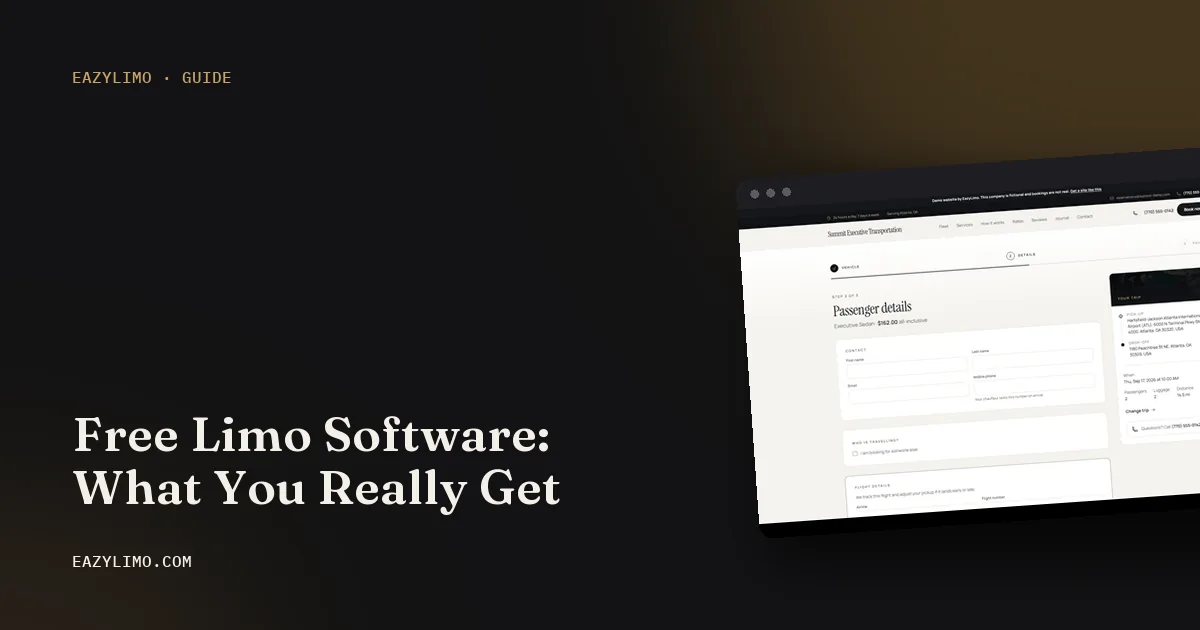
- Try a real booking on the live demo to compare the experience with a free tool.