Guides
How Much Does a Limo Website Cost? (2026 Price Breakdown)
What decides the real cost of a limo website in 2026: the four ways to get one, the hidden running costs most quotes leave out, and how to compare options over three years.
EazyLimo Team 7 min read
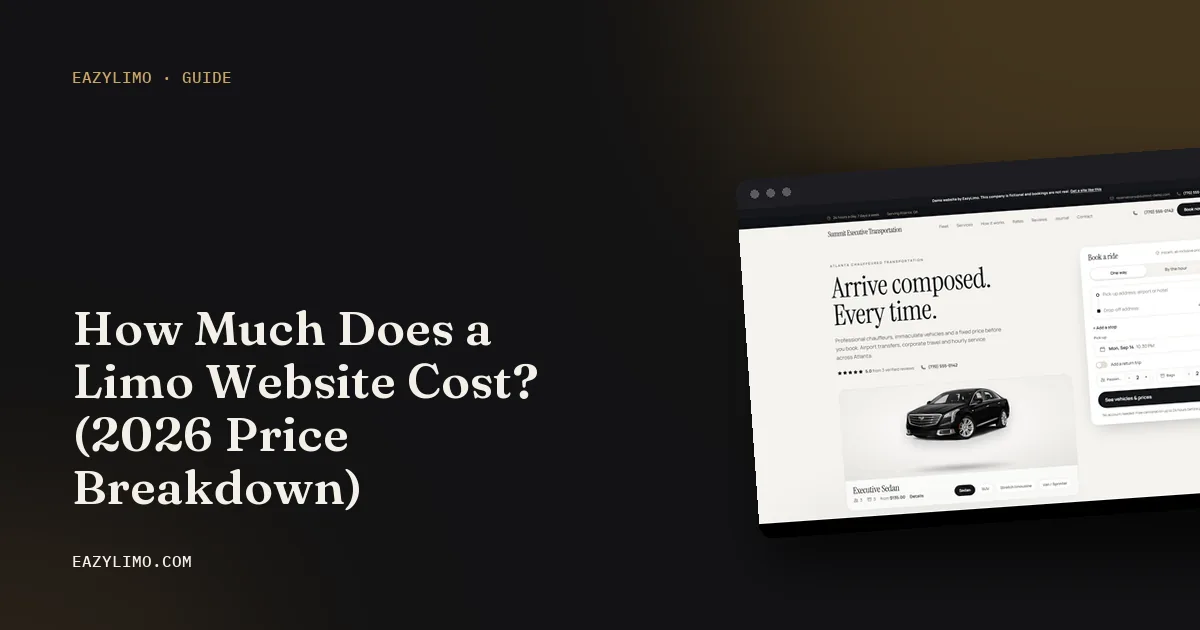
Ask five web designers what a limo website costs and you will get five very different answers. That is not because anyone is hiding the price. It is because "limo website" can mean a one-page brochure, or it can mean a full booking system with instant quotes, card payments and driver assignment.
This breakdown explains the four common ways to get a limo website, what drives the price of each, the running costs most quotes leave out and how to compare options fairly over three years. We do not quote other providers' prices here, because they change often and depend on scope. Instead, you will get the questions that turn any quote into a number you can compare.
What you are actually paying for
Before comparing prices, decide what the website needs to do. For a small limo business, the features usually fall into three groups:
The website itself
- Pages for your fleet, services, airports and service area.
- Mobile-friendly design that loads quickly.
- SEO basics such as page titles, descriptions and a sitemap.
- Your own domain name and business email.
The booking system
- Instant quotes calculated from your rates, including minimums, mileage bands, hourly rates and flat routes.
- Airport bookings that collect flight details.
- Card payments, deposits or pay the chauffeur options.
- Confirmation emails for the passenger and alerts for you.
Operations tools
- A dispatch board and driver assignment.
- Trip texts to drivers and passengers.
- Corporate accounts with monthly invoices.
- Farm-out to partner operators.
A quote for "the website" alone and a quote for all three groups are very different projects. Write down which features you need before you ask anyone for a price. Our guide to limo website design covers what the site should include.
The four ways to get a limo website
1. Custom build from an agency or freelancer
A designer or agency builds a site to your brief. You get a unique design and, depending on the contract, you may own the code.
What drives the price: the number of pages, custom design work, copywriting, photography and above all whether they build a real booking and quote engine or connect a third-party form. A custom quote engine that understands mileage bands, airport fees and hourly minimums is a large piece of software, and it needs ongoing maintenance.
Questions to ask: Who owns the code and domain? Is booking custom or a plugin? Who fixes it if a payment update breaks checkout? What does maintenance cost each year?
2. Monthly limo website or software service
Some providers rent you a website, often bundled with booking or dispatch software, for a monthly fee.
What drives the price: the number of vehicles or drivers, the features in each plan, setup fees and sometimes per-booking or payment charges.
Questions to ask: Is there a setup fee or contract length? Are there per-booking fees? What happens to the website, domain and customer data if you cancel? Does the price rise when you add a second vehicle?
3. DIY template or website builder plus a booking plugin
You buy a template or subscribe to a website builder and set it up yourself, often adding a booking plugin.
What drives the price: the template or builder plan, premium plugins, hosting, and the value of your own time. Setting up rates, maps, payments and email notifications correctly takes longer than most owners expect.
Questions to ask yourself: Can the plugin calculate quotes the way you price trips? Who updates it? How many evenings will setup take? We compare this path in detail in limo website template vs a done-for-you limo website.
4. Done-for-you limo website you pay for once
A provider that specializes in limo businesses builds the site on your domain with booking already built in, sets up your rates and hands it over. You pay a one-time fee, with optional hosting and updates.
What drives the price: how much is included in the build, whether booking and operations tools come with it and what the yearly hosting option covers.
Questions to ask: Do I own it? Does money go straight to my own payment account? What does hosting include? Can I move hosts later?
Hidden costs most quotes leave out
The build price is only part of the cost. These running costs apply to almost every option, so ask about each one:
| Cost | What it is | How to check it |
|---|---|---|
| Domain name | Yearly renewal for your web address | Your domain registrar's renewal price, not the first-year promo |
| Hosting | The server that runs your site | Ask if it is included and what happens at renewal |
| Updates and security | Keeping the software, plugins and certificates current | Ask who does it and whether it is included |
| Maps and routing | Address search and distance for instant quotes | Check the map provider's current pricing page and your expected usage |
| Payment processing | Card fees on each online payment | Check your payment provider's published rates |
| Text messages | Trip texts to drivers and passengers | Check your SMS provider's per-message pricing |
| Business email | An address on your own domain | Check your email provider's per-user price |
| Your time | Setup, fixes and content changes you do yourself | Estimate hours and value them honestly |
Also check whether a provider adds its own fee on top of each booking or payment. A small per-booking fee can add up quickly once you are busy.
Compare the total cost over three years
The fairest way to compare a one-time price with a monthly price is to add up everything you would pay over three years. Three years is roughly how long a small operator might run one website before a redesign.
Use this worksheet. Fill in the quotes you receive for each option.
| Cost item | Custom build | Monthly service | DIY template | Done-for-you, owned |
|---|---|---|---|---|
| Build or setup fee | Your quote | Your quote | Template, plugins | Your quote |
| Monthly or yearly fees x 3 years | Maintenance plan | Monthly fee x 36 | Builder plan, plugin renewals | Optional hosting x 3 |
| Hosting and domain x 3 years | Your quote | Often included | Your quote | Domain, hosting if not taken |
| Per-booking or payment fees | Payment provider only | Ask | Plugin and payment provider | Payment provider only |
| Your setup time | Low | Medium | High | Low |
| Do you own it after 3 years? | Check contract | Usually not | Yes | Yes |
As a worked example with our own prices: an EazyLimo site at the founding price of $499, with optional hosting and updates at $199 a year for three years, totals $1,096. At the standard $999 price with the same hosting, it totals $1,596. On the monthly plan at $79 a month, three years totals $2,844, and you do not own the site. Payment processing and map usage are extra in every case, because they go through your own accounts.
What to ask before you sign
- Exactly which pages and features are included?
- Does the quote engine support my pricing: minimums, mileage, hourly, flat routes and surcharges?
- Do customer payments go straight to my own Stripe or PayPal account?
- Who owns the domain, the website and the customer data?
- What happens if I stop paying the monthly or yearly fee?
- Are there setup fees, per-booking fees or price increases for more vehicles?
- Who handles updates, security and broken features?
- Can I see a live example I can book through?
- How long until the site is live?
- Does it include SEO basics and airport or city pages?
A provider that answers these clearly is usually easier to work with later. To see how a real limo client's site came together, read the Executive Limo Atlanta case study.
Red flags in a limo website quote
- No live example. If you cannot book a test trip on a real site they built, you cannot judge the booking flow.
- The domain is registered in their name. Your web address should always belong to you.
- Payments go through their account first. Money should land in your own payment account, not wait for a payout from someone else.
- Vague maintenance terms. "Support included" means little unless you know who fixes broken bookings and how fast.
- No exit plan. Ask what you get to keep, such as customer data and content, if you leave.
Which option fits a one or two car operator
- Choose a custom build if you want a unique design and have budget for ongoing maintenance of a booking system.
- Choose a monthly service if you need very low upfront cost and are comfortable renting rather than owning.
- Choose a DIY template if you mostly need a brochure site and take bookings by phone.
- Choose a done-for-you site you own if you want booking built in without managing the tech yourself.
How EazyLimo prices a limo website
EazyLimo is a done-for-you limo website with online booking built in, made for owner-operators with one or two vehicles. You can pay once and own it for $999, with a founding price of $499 for the first 25 operators, or pay $79 a month with a 12-month minimum. Optional hosting and updates are $199 a year. It includes instant quotes from your rates, airport bookings with flight details, card payments through your own Stripe or PayPal, a dispatch board, corporate invoicing and airport and city pages. Full details are on the pricing page.
Next steps
- List the features you need using the three groups above.
- Get at least two quotes and fill in the three-year worksheet.
- Ask every provider the ten questions before signing.
- Book a test trip on the live demo to see what a finished limo booking site feels like.