Guides
From Uber Black to Your Own Black Car Company
A practical path for Uber Black and premium app drivers who want their own black car company: licensing and insurance, building direct clients the right way, a booking website and a 90-day plan.
EazyLimo Team 7 min read
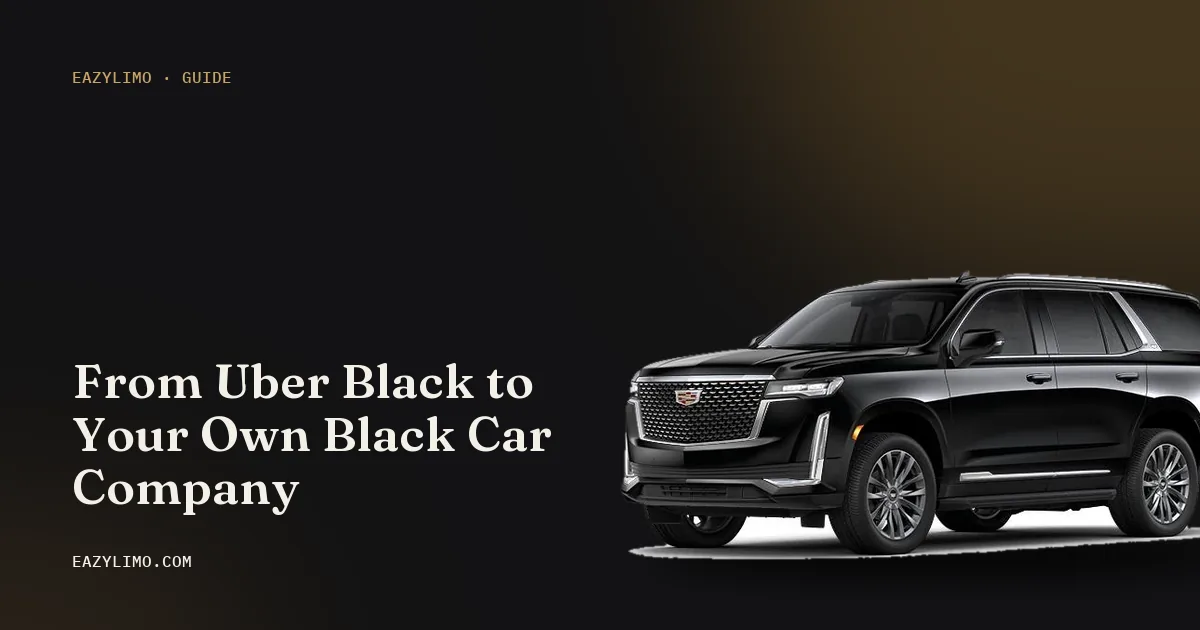
If you drive Uber Black or another premium app, you already have many of the pieces of a black car company: a qualifying vehicle, local knowledge, airport experience and the habits of a professional chauffeur. What you do not have is control. The app sets the price, chooses the rider and can change the rules at any time.
This guide is for drivers who want to build their own black car company, usually starting with the car they already drive. It covers why drivers make the move, how to do it without breaking app rules, the licensing and insurance you now need, and a 90-day plan. Rules vary by state, city and airport, so confirm each step locally.
Why drivers leave the apps
Every driver has their own reasons, but the common ones are:
- Price control. On an app you accept the fare offered. With your own company you set rates that cover your real costs.
- Account risk. Your income depends on keeping access to someone else's platform. A deactivation or a policy change can stop it overnight.
- Client relationships. Riders belong to the app. Direct clients belong to you and can book again and again.
- Better trips. You can focus on airport runs, corporate travel and events instead of taking whatever comes next.
- Something to build. A company with a name, a website, repeat accounts and maybe a second car has value beyond this week's driving.
The trade-off is that you now do the work the app did: finding customers, pricing, booking, payments and support. The rest of this guide is about doing that well.
Keep app work while you build direct clients
Very few drivers switch overnight. A steadier path is to keep some app driving for cash flow and add direct trips as they come in. Over time, direct work grows and app work shrinks.
To make that work:
- Block your best hours for direct clients. Early airport runs and weekday business travel are often the most valuable.
- Keep one calendar. Enter every direct trip immediately so you never accept an app ride that makes you late for a booked client.
- Separate your finances. Use a business bank account for direct work from the start.
- Track your numbers. Record fares, miles and hours for both kinds of work so you know when direct work pays better.
Licensing and insurance you now need
On an app, some permits and coverage are tied to the platform. Once you book trips yourself, you are the carrier, and the responsibility moves to you.
Operating authority and permits
- State authority: many states license for-hire passenger carriers through a transportation department or public utilities commission.
- City or county: some areas require a for-hire vehicle license, chauffeur permit and inspection.
- Airports: pre-arranged pickups by your own company often need a ground transportation permit that is separate from any app arrangement.
- Interstate trips: if you carry passengers across state lines for hire, check FMCSA's rules. FMCSA lists a one-time $300 fee for each operating authority.
Commercial insurance
Insurance that applies during app trips does not cover trips you book and dispatch yourself. You need your own commercial auto policy for for-hire passenger transport, with limits that meet your state, city, airport and corporate client requirements. Get quotes from brokers who work with livery businesses, and ask how the policy handles any app driving you keep.
The business itself
- Register a business name and structure with your state.
- Get a free EIN directly from the IRS.
- Open a business bank account and set up simple bookkeeping.
Our step-by-step guide to starting a limo business covers these in more detail.
Turning riders into repeat clients, the right way
This is the part many drivers get wrong. It is tempting to hand every good app rider a business card. Uber's Community Guidelines say drivers should never solicit or accept payment outside the platform, and a violation can cost you access. Other apps have their own terms. Read the current rules and your driver agreement before you do anything that involves app riders.
The safer approach is to build your own client base through your own channels:
- Your existing network. Friends, past employers, your church, gym or kids' school often include people who travel for work.
- Google Business Profile. Local people searching for a car service can find you directly. See our Google Business Profile guide.
- Hotels and concierges. A professional card and a booking link make it easy for them to recommend you.
- Event planners and wedding venues. They need reliable cars on busy weekends.
- Local businesses. Executive assistants and office managers book airport cars every week.
- Partner operators. Other small companies may farm out trips they cannot cover.
Your app experience still helps. You know which hotels, offices and airport terminals generate premium trips, and you already deliver the service level those clients expect.
Your website and booking link
When someone hears about you, the first thing they do is look you up. A website that shows your vehicle, your service area and a way to book turns that curiosity into a trip.
What your site needs as a new black car company:
- Your real vehicle, with passenger and luggage capacity.
- Instant quotes based on your rates, so clients get a price as fast as they would on an app.
- Airport booking with airline and flight number fields.
- Card payment at booking, or pay the chauffeur for known clients.
- A short booking link you can text to new contacts and print on your card.
- A clear cancellation policy. Use our cancellation policy template as a start.
App riders are used to booking in seconds. If your site makes them call, email and wait for a price, many will not bother. With one car, set lead times and buffers so online bookings never clash, as explained in online booking for a one-car limo business.
Your first corporate accounts
For a one-car company, a few corporate accounts can fill a large part of your week with predictable trips. Corporate clients usually expect:
- Consistent, on-time service and a professional vehicle.
- A named contact who answers quickly.
- Monthly invoices instead of paying per trip, often with PO numbers or cost centers.
- Certificates of insurance for their files.
- A simple way for assistants to book for several travelers.
Start with companies you can reach: former employers, local firms near the airport and businesses whose executives you already drive through your network. Offer a first trip at your normal rate, deliver it perfectly and ask if they would like an account. The corporate black car use case shows how monthly billing and repeat bookings work in practice.
Price your own trips
Do not copy app fares. Your rates must cover commercial insurance, permits, vehicle costs, fuel, maintenance, marketing and the empty miles back from a drop-off. Build a rate card with minimum fares, airport flat routes, hourly minimums and surcharges for late nights or extra stops. Our guide to pricing airport transfers walks through the math.
Common mistakes when leaving the apps
- Taking direct trips before authority and insurance are active. One incident on an uninsured trip can end the business.
- Soliciting app riders. It risks your app access, which you may still need for cash flow.
- Underpricing to win clients. Low rates are hard to raise later, and they rarely cover commercial insurance.
- Relying on texts and memory. Without one booking system, a missed pickup is only a matter of time.
- Waiting for a perfect website. A simple site with working booking beats a beautiful one that is still unfinished.
A 90-day plan
| Period | Focus | Actions |
|---|---|---|
| Days 1 to 30 | Get legal and insured | Register the business, get an EIN, open a bank account, apply for state, city and airport authority, get commercial insurance quotes, choose a name |
| Days 31 to 60 | Get bookable | Set your rate card and cancellation policy, launch your website with online booking, set up Google Business Profile, print cards with your booking link |
| Days 61 to 90 | Get clients | Contact your network, visit hotels and venues, pitch five local companies for corporate accounts, ask every client for a review, track direct vs app earnings |
Timelines depend on how long your state, city and airports take to process applications. Do not take direct paid trips until your authority and insurance are in place.
A website built for this move
EazyLimo builds done-for-you limo websites with booking built in for owner-operators with one or two vehicles, which fits drivers leaving the apps. Clients get instant quotes from your rates and can book airport trips with flight details and pay by card through your own Stripe or PayPal. Corporate accounts get monthly invoices with PO numbers. You can pay once and own the site, or pay monthly. See pricing or try the demo.
Next steps
- Read the current app guidelines and your driver agreement so your plan stays within the rules.
- Contact your state agency, city and airports about authority and permits.
- Get commercial insurance quotes for the car you already drive.
- Set your rates, launch your booking site and start the 90-day plan. When you are ready, get started.